Maxicode (ISO 16023) - Barcode Type
Developed by UPS, the Maxicode symbology employs a grid of hexagons surrounding a 'bulls-eye' finder pattern. This symbology is designed for the identification of parcels. Maxicode symbols can be encoded in one of five modes. In modes 2 and 3, Maxicode symbols are composed of two parts named the primary and secondary messages. The primary message consists of a structured data field which includes various data about the package being sent, while the secondary message usually consists of address data in a data structure. The format of the primary message required by Zint is given in the following table:
| Characters | Meaning |
|---|---|
| 1-9 | Postcode data which can consist of up to 9 digits (for mode 2) or up to 6 alphanumeric characters (for mode 3). Remaining unused characters should be filled with the SPACE character (ASCII 32). |
| 10-12 | Three digit country code according to ISO 3166. |
| 13-15 | Three digit service code. This depends on your parcel courier. |
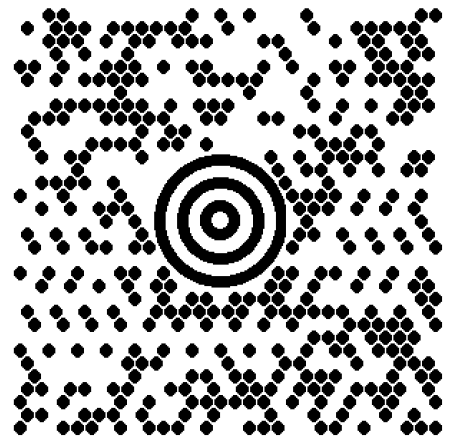
All modes support extended ASCII characters and number compression. The maximum length of text that can be placed in a Maxicode symbol depends on the type of characters used in the text. Example maximum data lengths are given in the table below:
| Mode | Maximum Data Length for Capital Letters | Maximum Data Length for Numeric Digits | Number of Error Correction Codewords |
|---|---|---|---|
| 2 (secondary only) | 84 | 126 | 50 |
| 3 (secondary only) | 84 | 126 | 50 |
| 4 | 93 | 135 | 50 |
| 5 | 77 | 110 | 66 |
| 6 | 93 | 135 | 66 |